Abu Simbel: An Egyptian Masterpiece

When I think about the A-list of travel destinations you absolutely must see in your lifetime, Egypt unquestionably makes the cut. For me, my first foray into Egypt not only brought to life the ancient pyramids, magnificent temples, and mysterious tombs I had seen in coffee-table books at my grandmother’s house as a kid; it also fundamentally changed my understanding of humans as a species.
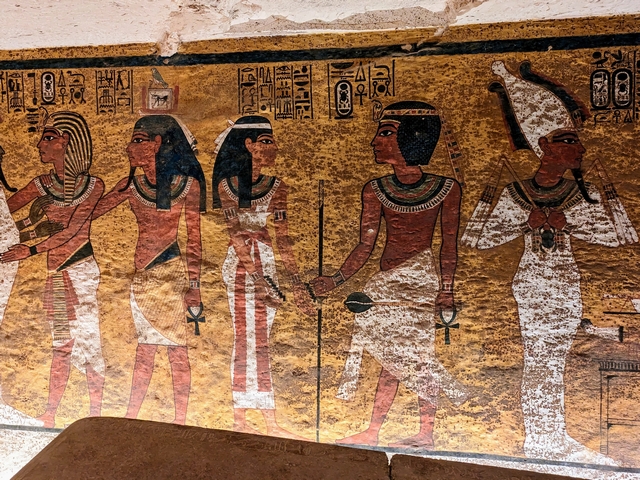
Painted mural on the north wall inside of King Tut's tomb in the Valley of the Kings in Luxor, Egypt. the images shows the Pharaoh Tutankamun followed by his soul embracing deities such as Osiris and greeting the goddess Nut.
Standing inside King Tut's tomb in the Valley of the Kings was a childhood dream come true for me.

I had never quite fully wrapped my mind around just how advanced ancient Egypt was until I experienced it for myself. There is something profound about standing in the shadow of a 4500 year-old pyramid constructed with human labor, or hearing voices from millennia past as your guide translates ancient hieroglyphics, leaving no questions about the stories they were meant to tell.
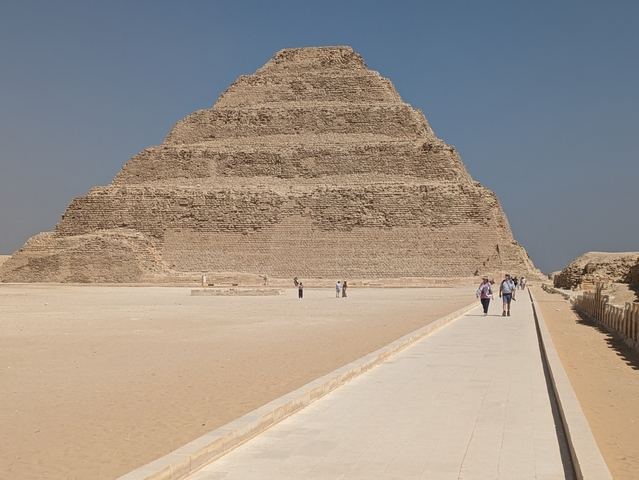
Tourists walking in front of the Step Pyramid of Djoser at Saqqara, Egypt.
At 4,700 years old, the Step Pyramid of Djoser at Saqqara will most certainly make you pause and reflect on the feats of ancient humanity.

Of all the Egyptian sites we visited, one of the most iconic and unforgettable was Abu Simbel, two magnificent temples carved directly into the rock by Pharaoh Ramesses II more than 3,000 years ago. The larger temple is dedicated to Ramesses himself and several of Egypt’s most important gods, while the smaller temple honors his chief wife, Queen Nefertari, alongside the goddess Hathor.
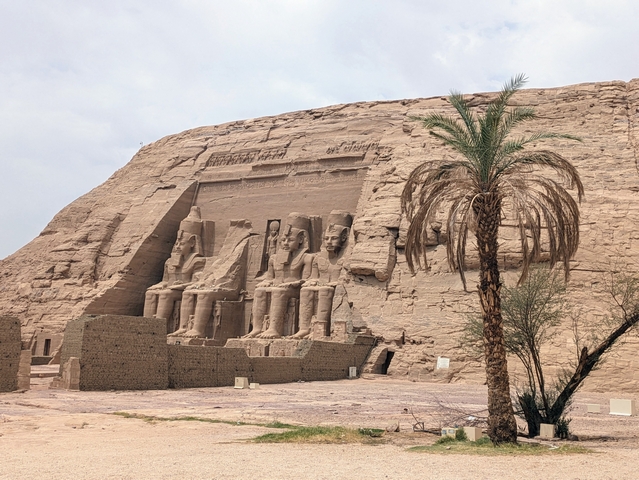
 

Image of the relocated Temple of Ramesses II at Abu Simbel, Egypt, showing a lone palm tree with the temple facade and four giant seated statues of Ramesses II behind it.
The larger of the two temples at Abu Simbel was carved directly into the stone over 3,000 years ago.

One of the most fascinating facts about Abu Simbel is that the temples you visit today are not actually in their original location. In the 1960s, as construction of the Aswan High Dam threatened to drown them beneath the rising waters of Lake Nasser, an international team painstakingly cut the temples into enormous blocks, moved them piece by piece to higher ground, and reconstructed them in their original form.
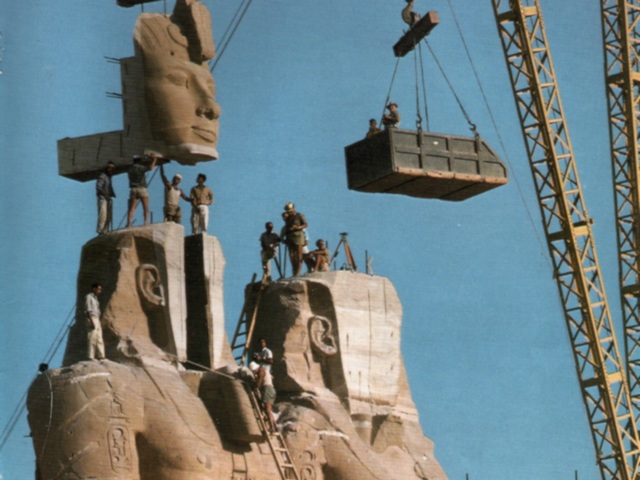
Work men stand atop two giant statues of Ramesses II as a crane lowers the giant carved stone into place during the relocation of the temples in 1967.
Workers stand atop two giant statues of Ramesses II as a crane lowers the carved stone facade into place during the relocation of the temples in 1967 (photo from Wikimedia Commons).

A morning spent exploring the temples at Abu Simbel is nothing short of awe-inspiring. It’s impossible not to stop dead in your tracks and let out an audible “WOW!” as you get your first glimpse of the imposing, 66-foot-tall statues of Ramesses II that guard the main temple. Once inside, the mood shifts from overwhelming grandeur to something more contemplative as you take in the sacred inner sanctuaries, towering statues, and magnificent stone reliefs depicting gods, pharaohs, battles, and stories from more than three thousand years ago.
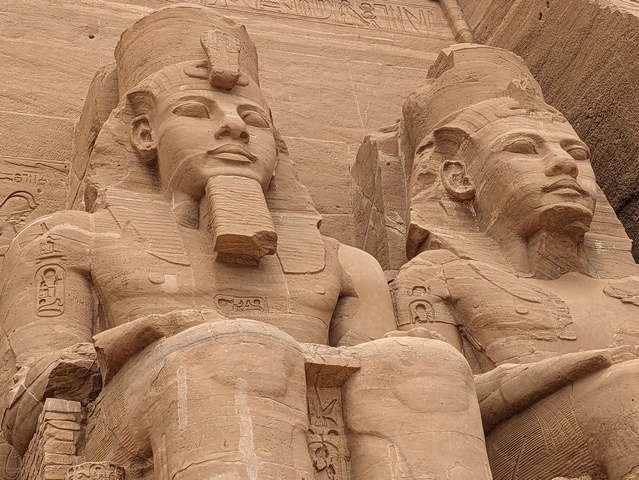
Close-up of two giant stone statues of Ramesses II that guard the entrance to the Great Temple at Abu Simbel.
The four colossal stone statues of Ramesses II that guard the entrance to the Great Temple will stop you in your tracks as you approach the entrance.

Best of all is the fact that the Temples of Abu Simbel can be experienced in almost complete solitude on a private tour. Because these temples lie outside the reach of the standard Nile River cruise routes between Luxor and Aswan, you don’t get the sudden pulses of cruise ship traffic that inundate many of Egypt’s other great monuments. Traveling as a small and nimble party of two, we were some of the first visitors to make it to Abu Simbel, and having the temples almost entirely to ourselves for nearly 45 minutes before the first large groups started to arrive was such a peaceful, memorable, and almost surreal experience.
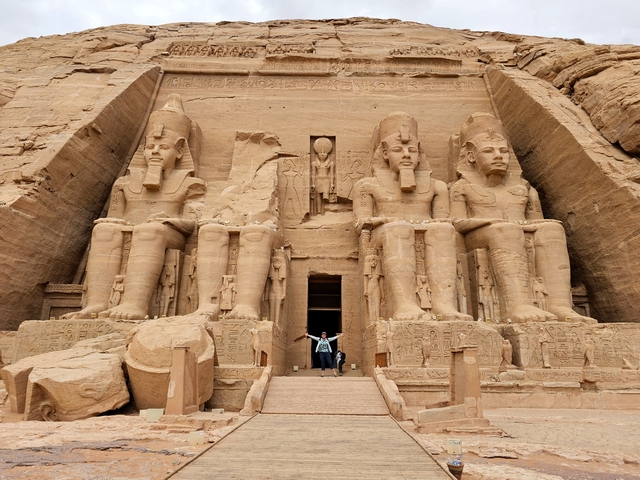
A lone traveler dwarfed next to the 4 giant stone statues of Ramesses II at the Great Temple of Abu Simbel, Egypt.
Having the Great Temple nearly to ourselves for 45 minutes before the large groups arrived was a highlight of all of our time in Egypt.

The following photos highlight the grandeur, artistry, and intrigue of these masterful monuments. Enjoy! 

The Great Temple of Ramesses II
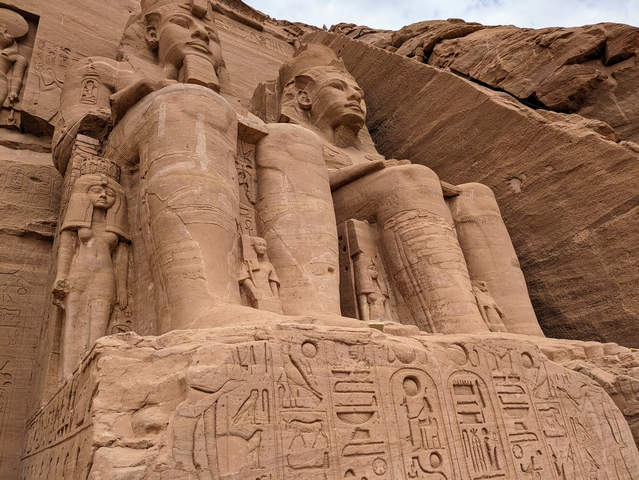
Looking up from below at two of the giant statues of Ramesses II carved into the stone at the Great Temple of Abu Simbel in Egypt.
The four colossal statues guarding the main temple at Abu Simbel depict the Pharaoh Ramesses II surrounded by members of his family. They were carved over 3,300 years ago and were almost completely covered by desert sands until they were rediscovered in 1813.
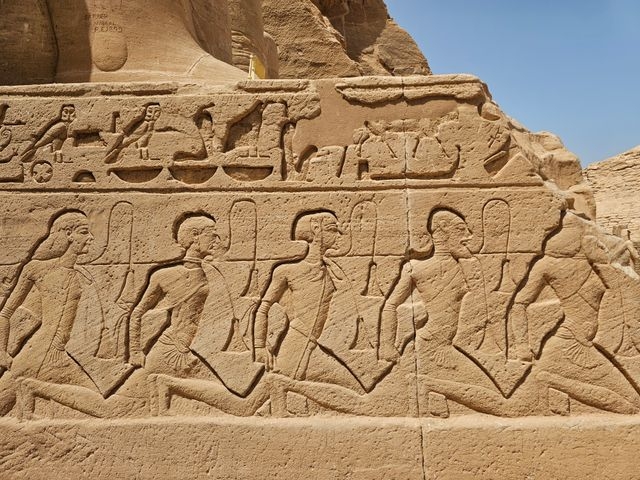
Stone relief carving on the base of the Great Temple of Abu Simbel, Egypt, showing a line of 5 prisoners tied down being dominated by Pharaoh ramesses II.
The main temple symbolizes the supreme divine power and military dominance of Ramesses II. This stone relief carving on the outside of the temple shows prisoners captured by the Pharaoh, demonstrating his ability to suppress chaos and maintain cosmic order.
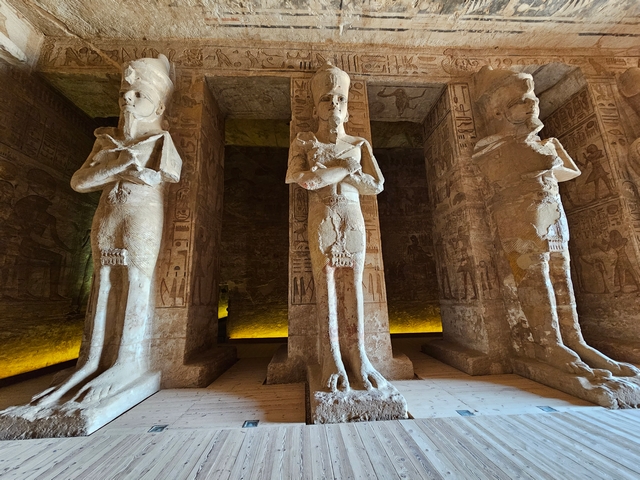
Three tall stone statues of Ramesses II represented as Osiris, found inside the great hall of the Great Temple of Abu Simbel.
Eight colossal statues of Ramesses II depicted as the god Osiris greet you inside the main temple. Osiris was the Egyptian god of the afterlife, and this hallway depicts Ramesses II’s status as a divine ruler and living god.
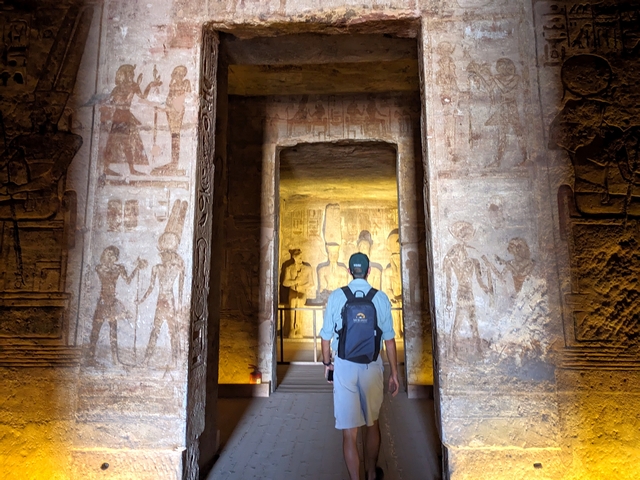
A visitor walks through a stone doorway adorned with images of Ramesses II and the gods inside the Great Temple of Abu Simbel, Egypt.
Bas-relief engravings on the way to the temple's inner sanctuary show Ramesses II making offerings and paying homage to various Egyptian creator gods.
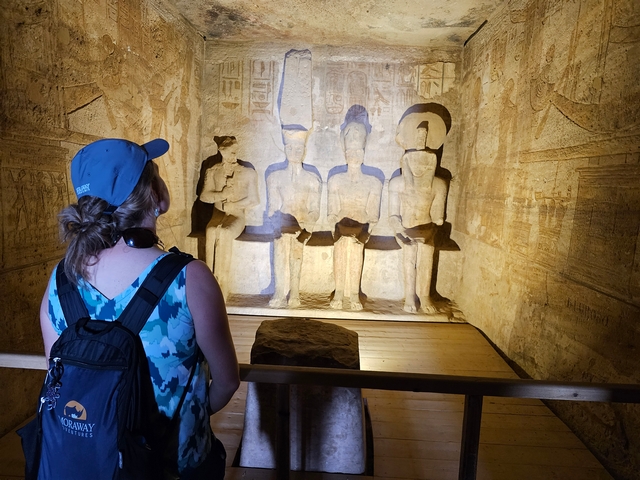
A visitor looking at the four stone statues of the gods inside the inner sanctuary of the Great Temple at Abu Simbel, Egypt.
The inner sanctuary holds stone carvings of Ramesses II seated next to the gods Ra, Amun, and Ptah. On February 22 and October 22, the sun’s rays penetrate 180’ deep into the temple to illuminate all the statues except Ptah, god of the underworld, who remains shadowed in darkness year-round.
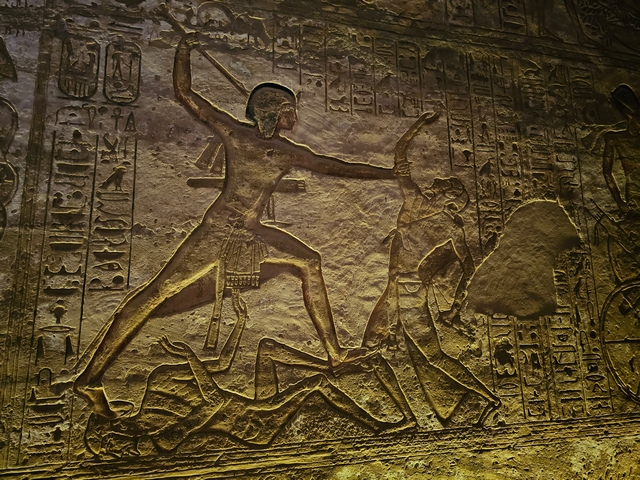
Stone relief carving inside the Great Temple of Abu Simbel, Egypt, showing a larger-than-life Ramesses II slaying one enemy while trampling another at the Battle of Kadesh.
This impressive stone carving inside the temple shows a larger-than-life Ramesses II slaying one enemy while trampling another at the Battle of Kadesh. The stone reliefs inside the temple highlight Ramesses II’s military prowess, serving as political propaganda and intimidating any potential invaders.
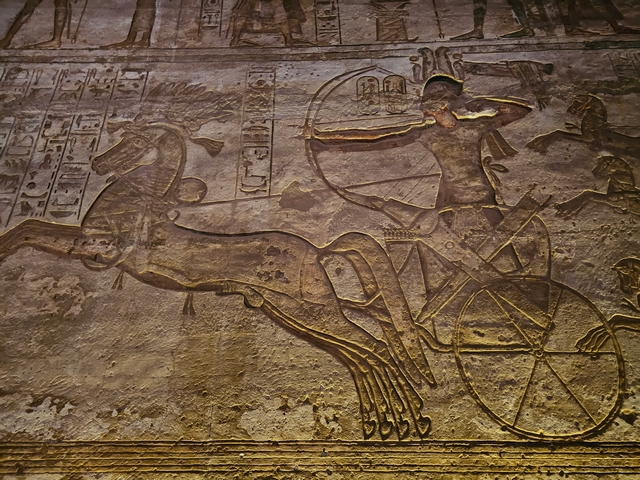
Wall carving inside Great Temple of Abu Simbel, showing Ramesses II firing a bow and arrow from a chariot.
The Battle of Kadesh was the largest chariot battle in recorded history, with 5,000 to 6,000 chariots involved. This image depicts the moment of Ramesses II’s legendary counter-charge against the enemy, with the accompanying hieroglyphics describing him as “steady upon the chariot . . . a victorious bull, attacking hundreds of thousands single-handedly.”
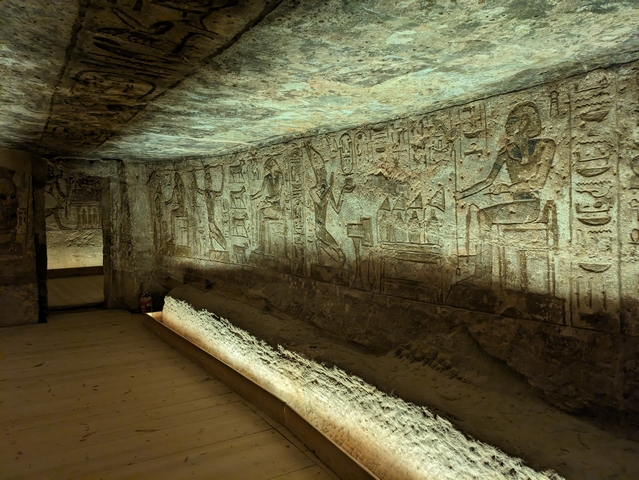
Wall carvings inside a small room at the Temple of Abu Simbel in Egypt, showing images of the Pharaoh Ramesses II and a long, stone bench used to store ceremonial objects.
Smaller inner chambers of the Great Temple depict offerings to the gods, and these rooms were likely used as storerooms for ritual objects and temple equipment. The carved stone benches were not used for seating, but rather to keep sacred objects off the ground.

Small Temple of Hathor and Nefertari
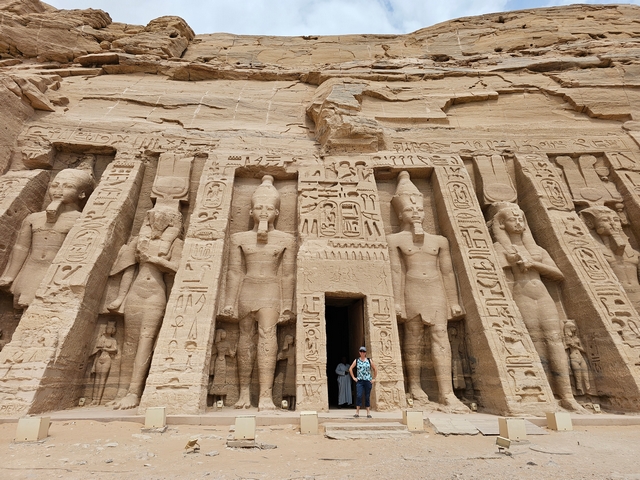
A traveler standing inside the door at the main entrance of the Small Temple of Hathor and Nefertari at Abu Simbel, flanked by three giant carved statues of Nefertari and Ramesses II on either side of the door.
The second, smaller temple at Abu Simbel was built for Ramesses II’s chief wife, Nefertari. It was extremely rare in ancient Egypt for statues of queens to be of equal size to those of kings, proof of Ramesses II’s reverence for his queen.
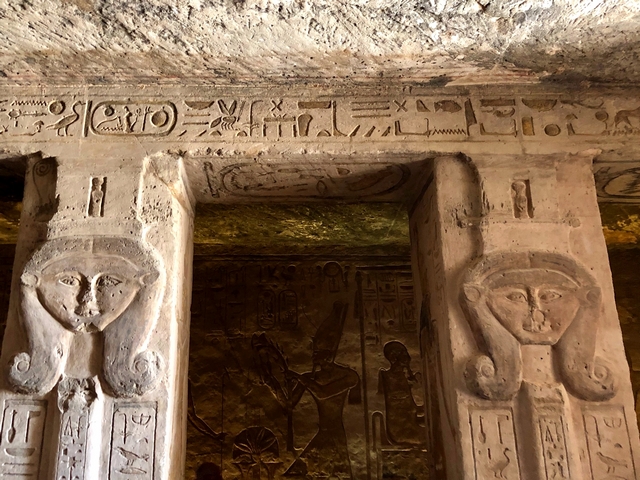
Two stone carvings representing the Egyptian goddess Hathor near the top of two columns inside the Small Temple of Hathor at Abu Simbel, Egypt.
When you step inside the smaller temple, you are greeted by six stone pillars with carvings of the goddess Hathor, with a human face and cow-shaped ears. Hathor was the goddess of love, fertility, motherhood, and joy.
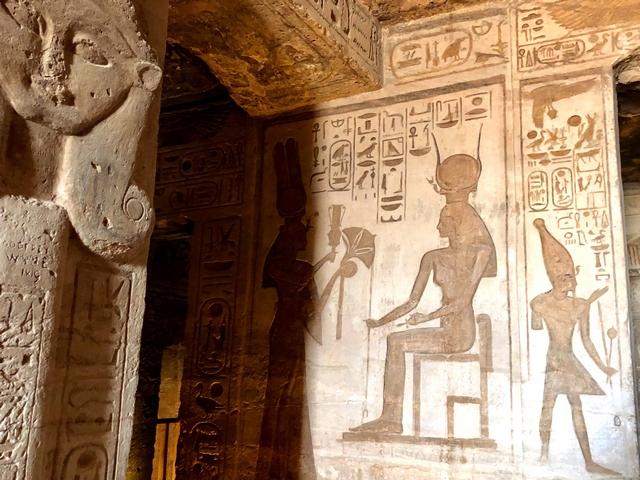
A glimpse inside the Small Temple of Hathor at Abu Simbel, Egypt, showing a carved stone head of the goddess Hathor on a pillar, and a stone relief carving showing Nefertari making an offering to a seated Hathor.
This relief carving shows Nefertari (in the shadow) making an offering of papyrus to Hathor while rattling a sistrum, a sacred rattle used to invoke the gods during temple ceremonies.
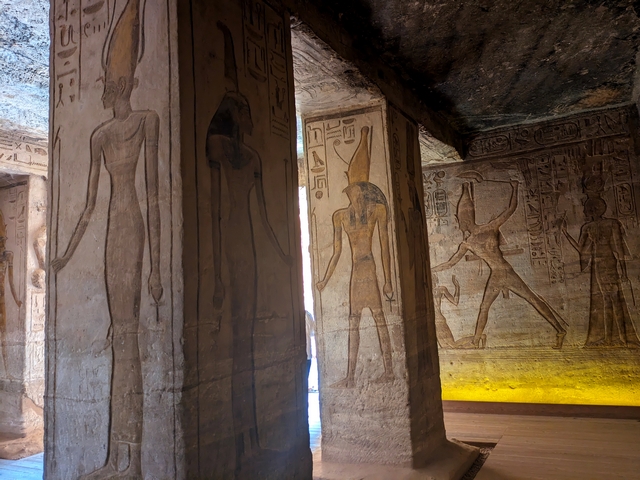
Artwork etched into stone on the columns and walls inside the Small Temple of Hathor at Abu Simbel, with portraits of various gods and an image of Ramesses II smiting an enemy as Queen Nefertari looks on.
Backsides of the Hathor-headed pillars showing other various gods, plus Nefertari looking on as Ramesses II smites the enemy.

Ready To Stand In Awe At The Great Ramesses II For Yourself?

Let’s connect!

We can help you customize your dream Egyptian adventure, tailored fully to you.

Your Friendly Adventure Travel Expert,
Alexis Alloway

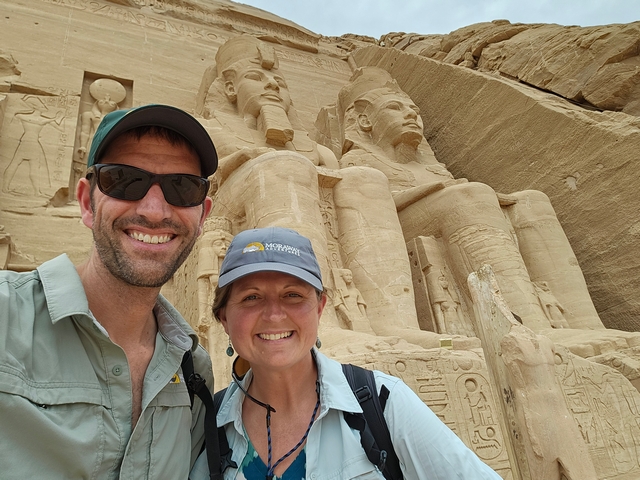
A smiling couple standing next to two giant stone statues of Ramesses II at the entrance to the Great Temple at Abu Simbel, Egypt.

Let’s Stay In Touch

Subscribe to our newsletter

Contact Us